

Approval certificate?
No
CPNP is a notification service.

Enter the EU cosmetics market with the correct regulatory framework in place. NKG supports international manufacturers and beauty brands with Product and Label Compliance, EU Responsible Person services, PIF & CPSR preparations, CPNP notification, and end to end regulatory support.
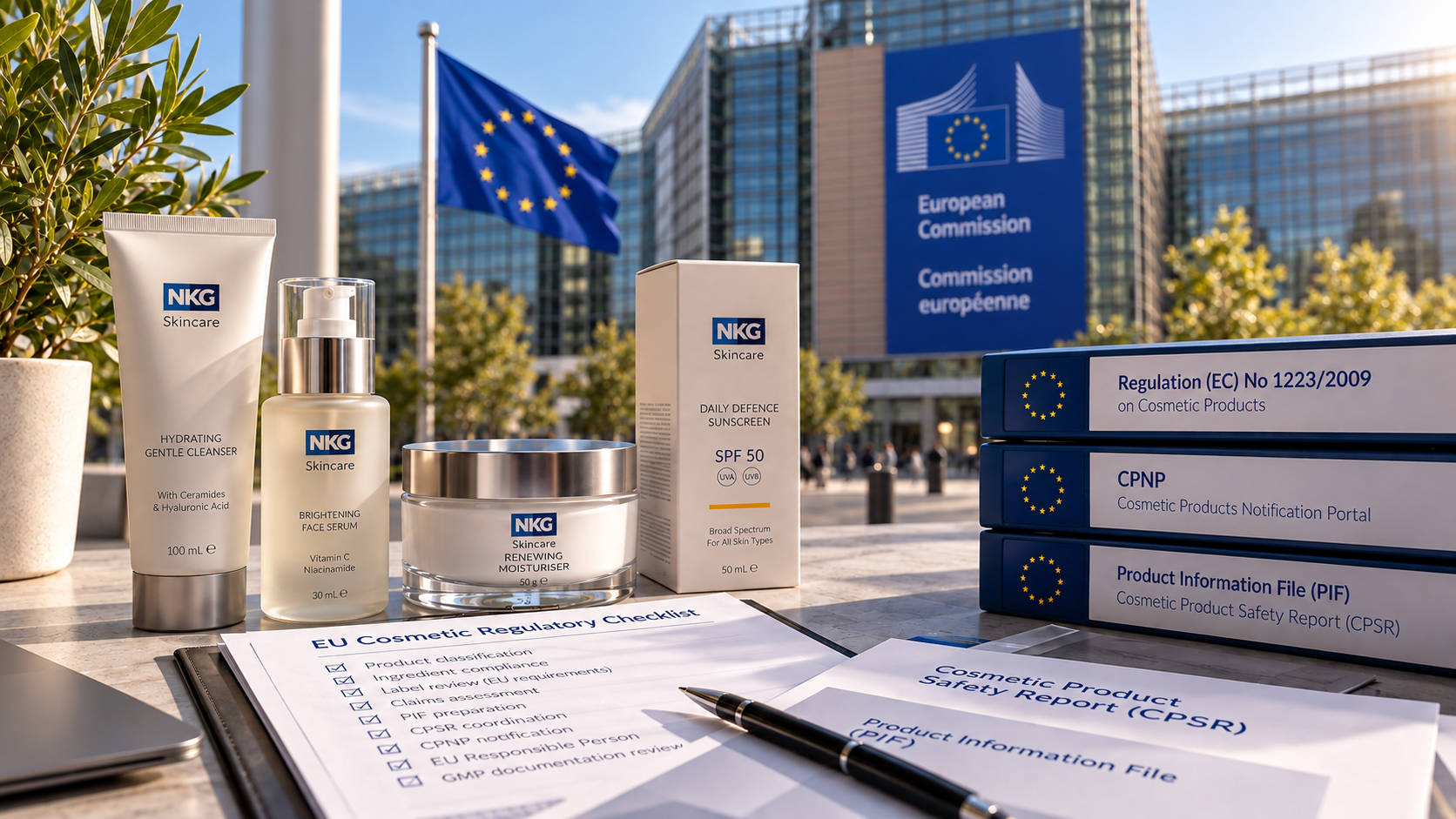
European Union · Cosmetics
| Primary regulation | Regulation (EC) No 1223/2009 on Cosmetic Products |
| Market | European Union |
| Notification service | CPNP (Cosmetic Products Notification Portal) |
| Responsible Person | Required and established in the EU |
| Safety assessment | PIF and CPSR required and maintained in English |
| Product safety assessment | Required before market placement |
| Product notification | Mandatory before market placement |
| Compliance model | Pre-market compliance plus notification |
Important regulatory notice
Submitting a product through CPNP does not by itself make it compliant. The Responsible Person, product safety assessment, CPSR, PIF, ingredient, GMP and labelling requirements must also be satisfied before EU market placement.
Cosmetic Products Notification Portal
CPNP stands for the Cosmetic Products Notification Portal, a free online notification system created by the European Commission to implement Regulation (EC) No 1223/2009 on cosmetic products.
Before a cosmetic product is marketed in the EU, it must be notified through CPNP by the EU Responsible Person.
CPNP is a notification system—not a cosmetic product approval certificate.
Only products for which a legal or natural person established in the EU is designated as Responsible Person may be placed on the market. This role coordinates compliance across safety, CPSR, PIF, GMP, notification, labelling, claims and post-market obligations.
International manufacturers do not necessarily need their own European subsidiary simply to place cosmetics on the market.
A qualifying legal or natural person established in the EU must act as Responsible Person.
Local commercial, tax, distribution and other requirements should be assessed separately.
NKG keeps in Close communications with various Trade Commissions,Business Chambers, embassies of many countries on various existing & new Rules & Regulations of government of India































Formulations must comply with current EU restrictions and permitted-use conditions before a cosmetic product is placed on the market.
Assess prohibited and restricted substances, preservatives, UV filters, colourants, CMR substances, allergens, nanomaterials, concentrations and applicable conditions of use.
Monitor EU regulatory changes affecting prohibited ingredients, restricted substances, UV filters, CMR substances, preservative labelling and applicable transitional provisions.
Regulation (EC) No 1223/2009 governs cosmetic products placed on the EU market, including requirements relating to product safety, documentation and notification.
Formula compliance comes before notification
Review Responsible Person details, product function, nominal content, durability or PAO, precautions, batch identification, origin for imports, ingredients, warnings, applicable national-language requirements, claims and presentation.
Assess product benefits, efficacy, ingredients, natural or organic positioning, sensitive-skin, anti-ageing and dermatological claims—including wording that may create medicinal classification risk.
Before market placement, the Responsible Person must ensure a safety assessment is completed and a CPSR is prepared. Part A covers safety information such as composition, characteristics, quality, exposure and toxicology. Part B records the suitably qualified safety assessor’s conclusion and reasoning.
The safety assessment must be performed by a suitably qualified professional as required by the Regulation.
The PIF brings together the product description, CPSR, manufacturing method, GMP statement, evidence supporting claimed effects where justified, and applicable animal-testing data.
NKG supports preparation, organization and ongoing maintenance.
The exact information depends on the product. NKG coordinates the applicable dataset and supporting images before submission.
Indicative timing
Timing depends on product count, formula complexity, ingredient and label review, safety documentation, PIF completeness, Responsible Person setup, portfolio size, corrections and client response time.
After notification
Approval certificate?
No
CPNP is a notification service.
Market placement possible?
Yes
Once all applicable requirements are satisfied.
PIF and CPSR current?
Yes
Maintain it throughout the lifecycle.
Responsible Person in place?
Yes
The role must continue.
Notification updates?
Yes
Where relevant notified information changes.
Ongoing EU compliance
Changes are assessed for their actual effect on the PIF, CPSR, label and notified information—without blanket re-notification assumptions.
Review whether PIF, CPSR, CPNP or label updates are needed.
Assess continued compliance and safety before implementation.
Review updated artwork and any effect on notified information.
Update relevant records and notification information where required.
Keep safety and technical documentation current.
Report applicable cases to the relevant national authority.
Track evolving ingredient, labelling and technical requirements.
Support corrective action and authority coordination when necessary.
Who we work with
Why NKG
From formula review to CPNP and post-market maintenance.
Regulatory representation through qualifying arrangements.
One coordinated regulatory workflow.
Align technical documentation before notification.
Support across India, UAE, UK, EU and USA.
Support continues after CPNP notification.
Global offices
Supporting clients across 40+ countries through NKG’s global regulatory network.
Frequently asked questions
The essentials on CPNP, Responsible Person, safety documentation and lifecycle compliance.
CPNP stands for the Cosmetic Products Notification Portal, a free online notification system created by the European Commission to implement Regulation (EC) No 1223/2009 on cosmetic products.
A single CPNP notification supports market access across the 27 European Union Member States and the three EEA countries—Iceland, Liechtenstein and Norway—where the EU cosmetics framework applies.
Yes. Cosmetics placed on the Northern Ireland market must be notified through CPNP by a Responsible Person established in Northern Ireland or the EEA.
Yes. Every cosmetic product placed on the EU market must have a Responsible Person established within the EU or EEA.
Depending on the supply structure, the Responsible Person may be the manufacturer, importer, distributor in specified circumstances, or another person appointed by written mandate and established in the EU or EEA.
No. CPNP is a notification system, not a product approval certificate. The product must independently satisfy all applicable cosmetic requirements.
Yes. The Responsible Person must maintain an up-to-date Product Information File and make it readily accessible to the relevant competent authority.
Yes. A Cosmetic Product Safety Report is required before the cosmetic product is placed on the market.
Mandatory label information must appear in the language or languages required by each country where the product is made available
Yes. The country of origin must be stated for cosmetic products imported into the EU or EEA.
Yes. One suitably established Responsible Person may cover products marketed across multiple EU and EEA countries, provided all applicable obligations are fulfilled.
Assess the impact on ingredient compliance, safety documentation, PIF and CPSR, labelling and CPNP information before implementation.
NKG can support assessment, Responsible Person arrangements, ingredient and label review, safety documentation, PIF and CPSR, CPNP notification and post-market compliance according to scope.
NKG Advisory Contact
We’re here to support your regulatory needs—from initial review through CPNP notification and ongoing compliance.
NKG Advisory